Short Snippet
Cargo Movement (YOU KNOW WHAT I THINK? Barnfather Books, 2022)
WARNING
This speculative short story expands on events that take place in the world of Canuckia in 2206.
AUTHOR’S NOTE
Um, I don’t have much to say about this short story. The narrator explains everything. Thank goodness. But I will comment on the story’s format. You’ll notice that the text is either blocked or in the half-shape of a tree growing out of the ground. The blocks represent the world of roads—the main character’s cage—and the tree represents his memory of the past. The words that are capitalized represent—
You know what? You’re all smart, I bet you can figure it out. So . . .
Keep moving forward.
DISCLAIMER
The following publication is a piece of fiction. Names, characters, events, and incidents are products of Stefanie Barnfather’s imagination. Any resemblance to actual persons and/or events is coincidental, except for satirical purposes. Ms Barnfather in no way represents the companies, corporations, brands, or historical figures mentioned in her stories.
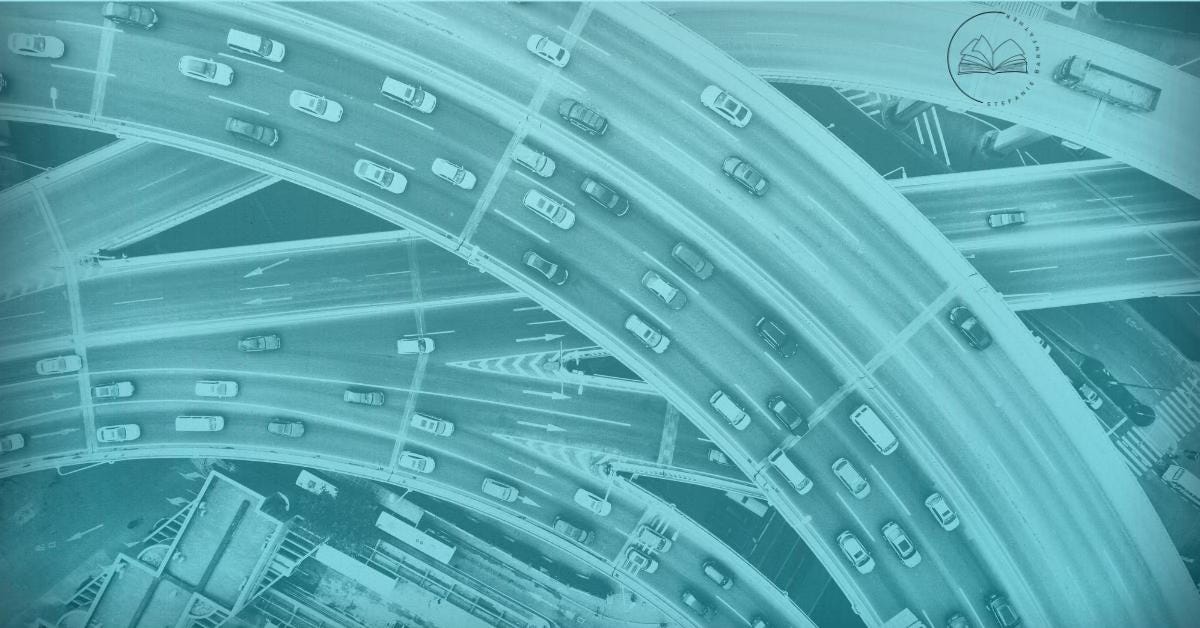
Cargo Movement
story three
THERE’S NO ROOM to move, but everyone keeps driving. After we steered into the skid and embraced the holistically vehicular life, humanity got what it wanted. We became a societal pendulum and the new world swung between what we feared and what we needed. Tight proximity. Total connectivity. Technology that fused us together. Permanent, inflexible, unchanging. Squished. Cramped. Close. MY FAMILY WAS one of the first to join the Cargo Movement. We migrated, transferring into our truck and taking to the road as the government bulldozed our home to make way for the interconnected transcontinental roadway system. My grandmother was one of the architects who designed the ocean’s pavement pathways. Her name is synonymous with modern development. Our brand is associated with royalty. I am a Prince. I can’t breathe. MY CAR IS small, like most of them are these days. Not like when I was young and our truck fit all five of my family members and our belongings with space to spare. When I got my graduated licence at fourteen, chose my driving co-pilot, then moved out and into my own home—my own vehicle, my own car—the government had already passed regulation that wouldn’t allow vehicles larger than two-seaters to be manufactured. “Better for the environment,” they said. “Easier on the wallet,” was the claim. “Nobody wants compartmentalized separation, anyway. We want vehicles to drive side by side. We want vehicles so there’s no privacy, no primacy, no personality—so there’s no point in us creating larger units anymore. Larger units are a thing of the past. A troubled past, and one that we are driving further and further away from, thanks to people like your grandmother. So, our apologies, your majesty, but what you want is no longer possible.” WHAT ENVIRONMENT? I said. Nature had been paved over to put up paradise. Greenery wasn’t necessary or viable. All production had been moved underground. All manufacturing had been moved underground. All cultivation had been moved underground. The surface was for driving. The environment was rock and stone and signage and traffic lights. WHAT WALLETS? I said. Currency was obsolete. Everything we needed—from tire repair and charging stations to nutrient rations and driving equipment—was provided. We have no wallets, because we have no money, because there’s nothing we need to beg for. The government provides. Now, we travel, we’re united, we belong, we’re taken care of. It works. NOBODY WANTS SEPARATION, I thought, alone in my two-seater with my driving partner. After two hundred years of endemic, pandemic, and epidemic isolation, humanity rejected rejection and shifted to a we-are-one model of interaction. Without homes or offices or theatres, stadiums, playgrounds, arenas—with nothing but cars—we became surrounded by an ever-travelling community of humans that coexisted on our global roads. Always moving forward as one, passing new caravans every day, our soul-spouse in the passenger seat, the electric systems in our vehicles taking us to our predetermined destinations, the landscape a solid sea of black-cracked concrete and sun-bleached road bumpers with metal grates to break up the monotony of our existential expressway of ennui and—
MY LIFE FEELS like a cage. I’m trapped. Unable TO inhale. When I was A CHILD I literally couldn’t inhale because of THE AIR pollution. Now that we live IN A NUCLEAR, electric, solar powered world the AIR IS CLEAN and fresh but my lungs aren’t able to take it in. Everything is tinted by the SCENT of metal. And PLASTIC FIXTURES. AND neon afterimage. It colours my VISION WITH ITS permanent spray of red TURN signals, blinking EXIT SIGNS AND buzzing infotisements, telling me and my co-pilot what MEALS WE’LL RECEIVE that evening and who WE’LL be PARKED BESIDE WHEN my TWO-SEATER pulls INTO OUR ASSIGNED lot—

“CURY,” SAYS SATURN, my side-seat driver, my navigation specialist, my race crew, my gearbox conductor. “You’re staring again.” I DON’T TURN from the window. Why would I? I know what Saturn looks like. I know how he’s sitting, foot resting on the dashboard, arm hanging out his window, hand flipping his aviators—up, shut, clear, shaded. He watches our daily driveo on our screeneo, a story about the perils of our past life. The heroine is chased through a forest by bees. The hero is dying under an avalanche slide. The heroix searches through rain, hail, sleet, cyclones, hurricanes, tornados, trying to connect, always apart, never reaching the safety of their loved one’s arms. The driveo is a horror story. A reminder of what we’re most afraid of. A way to remember what we’re hiding from that is safer than talk, safer than feeling, safer than sleep. Safer than memory. I hear the screams of the underground actors filling the car, but my eyes stay outside. SATURN SAYS, LOUDLY, “You never look at me anymore. Stop staring and wake up. For once.” His words are loud but his voice doesn’t resonate in the void. He whispers, hisses, wheezes, and moans. His speech is meant to engage, to hurt—ENRAGE!—but his energy is soft. Demure. Easy to block out. Easy to mute and pretend I’m in here by myself. SATURN’S ARMS ARE thin and pale. Our skin is safe, protected by the windshield’s UV glass, even though radiant rays are a non-issue because the ozone repaired itself. Saturn is thin and pale. We all are. Human muscles are no longer needed. Our diet is so strictly monitored we are perfectly balanced, unblemished versions of humans, unlike the messy, complex, inconsistent ones that ruined the earth. We are fragile. We get to be precious because our cars act as our legs. As our bodies. Our defences. I’M STARING OUT my window because that’s what I do. There was a time when royalty had a purpose. People like me were more than shallow symbols of success. Now, all I do is watch the roads ahead of us and behind, the different coloured cars moving by and moving on. We whiz along at a steady pace, never slowing, rarely stopping. I would gladly give up my symbols to leave this life, all my carbon crowns and rubber rings and broaches made of batteries. A car with two small passengers pass us by, the kids laughing at the forested driveo on their screeneo. They’ve never known a forest. How hilarious a tree must seem to them. I STARE OUT the window because I have seen a tree. The manufactured props on the driveo screeneo are nothing compared to the barky beasts from my childhood. The driveo maples are wilted. The driveo poplars are small. The driveo conifers are thin and pale. Their branches look like Saturn’s arms. Like his thighs, resting on top of his firm, supported, pleather, luxurious interior recliner. I don’t need to turn away from my window. I know what Saturn’s thighs look like—
